
How to record a DJ set that is worth sending
Promoters listen for thirty seconds. A phone recording of a room tells them nothing except that you own a phone.
- Audio
- 15 April 2026
- 5 min
- Kreators, Alfama
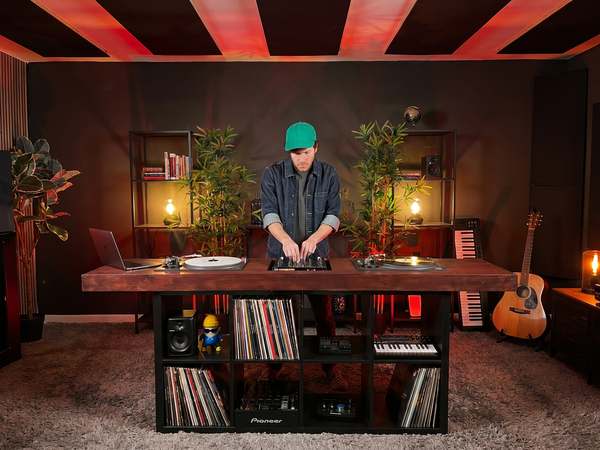
The booth in Alfama runs Pioneer CDJ-2000 Nexus players, a Pioneer DJM-750 mixer, Technics SL-1210 MK2 turntables and ADAM A7X monitors. The method below works on any comparable setup.
Take the signal from the mixer
Record the mixer's output, not the air. A DJM gives you a clean stereo feed with no room, no crowd and no phone compression — which is exactly what a promoter or a label wants to hear.
The room recording has one honest use: as a second track for atmosphere on a live set. It is never the main file.
Gain staging, in order
Set each channel's trim so the channel meter peaks in the upper part of its range without lighting the top, keep the channel faders near their working position rather than compensating with trim, and only then look at the master.
Leave the master peaking a few decibels below zero. Digital clipping on a recording cannot be undone, and a set that is three decibels quieter than someone else's costs you nothing — every platform normalises loudness anyway.
Vinyl and digital on the same mixer
The Technics SL-1210 MK2 is a quartz direct-drive turntable with a ±8 % pitch range, which is the reason it stayed the club standard for decades: the platter holds its speed and the pitch control is repeatable.
If you are mixing records against CDJs, match levels by ear at the channel trim before you record. A phono stage and a line input will not arrive at the same level on their own, and the difference is very audible in a recorded transition.
Monitor on something that tells the truth
The booth monitors are ADAM A7X with the X-ART ribbon tweeter. Nearfield studio monitors are less forgiving than a club rig — a mix that holds together on them tends to survive a big system, and the reverse is very much not true.
Check the recording on headphones afterwards as well. Beyerdynamic DT 990 PRO are in the booth for that.
Filming it doubles what you get
A recorded set is an audio file. A filmed set is a booking tool, an Instagram cut and a YouTube upload from the same two hours. The studio cameras and lighting are one door away, so filming is a request rather than a production.
Two things matter if you film: sync the camera to the mixer recording using a clap or a timecode-friendly clip at the top, and light the face, not just the equipment. Nobody books a pair of hands.
Short answers
- 01
How do I record a DJ set properly?
Record the mixer's output rather than the room, set the channel trims so nothing clips, and keep the master peaking a few dB below zero. Check the file on monitors and headphones before sending it.
- 02
What level should a DJ mix be recorded at?
Peaks a few decibels below full scale. Streaming platforms normalise loudness, so headroom is free and clipping is permanent.
- 03
Can I record a DJ set in Lisbon?
Yes. The Kreators booth in Alfama has CDJ-2000 Nexus players, a DJM-750 mixer, Technics SL-1210 MK2 turntables and ADAM A7X monitors, from €60 for two hours including VAT, and can be filmed on request.
- 04
Can I play vinyl in the booth?
Yes. The Technics SL-1210 MK2 turntables run alongside the CDJs on the same mixer.
More from the journal
The Shure SM7B needs more gain than you think
It is the most photographed microphone on the internet and the most badly gain-staged. Here is how we run it in the Alfama podcast room.
A video podcast is two productions at once
The failure mode is always the same: the episode looks fine and sounds like a conference call, or the other way round. Plan both, or drop one.
Where Lisbon actually makes things
The city is small enough to cross in half an hour and stubborn enough that each district still does its own thing. Here is who does what.
Come make something in Alfama.
Your need, your hour, Apple Pay. Walk up the hill, press record, and leave with the work done.
Kreators produces. bridgr connects. Kreators is the production studio and event space of bridgr, the creative residence and community in Alfama, Lisbon.