
The Shure SM7B needs more gain than you think
It is the most photographed microphone on the internet and the most badly gain-staged. Here is how we run it in the Alfama podcast room.
- Audio
- 11 February 2026
- 6 min
- Kreators, Alfama
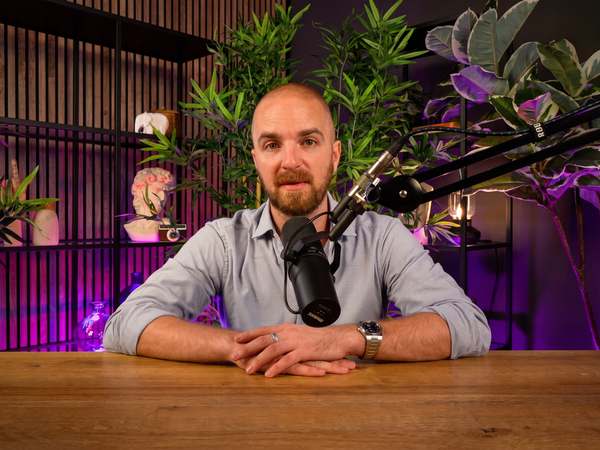
The SM7B is a cardioid dynamic microphone with a published sensitivity of −59 dBV/Pa. That single number explains almost every complaint people have about it.
Why it sounds quiet
Shure publishes the SM7B's open-circuit sensitivity as −59 dBV/Pa, roughly 1.12 mV per pascal. A large-diaphragm condenser typically sits some 20 to 30 dB above that. Nothing is broken: a passive dynamic capsule simply delivers a much smaller signal, and your preamp has to make up the difference.
In practice, a speaking voice at conversational distance needs around 55 to 65 dB of preamp gain to land at a healthy recording level. If your interface runs out of gain before that, you hear the preamp's own noise floor rise with the voice — the famous hiss that gets blamed on the microphone.
What we run it into
In the podcast room the SM7B and the Rode Procaster go into a Rodecaster Pro II, whose preamps are specified at up to 76 dB of gain. That headroom is the whole point: you set a level once, it stays clean, and nobody has to touch a knob mid-episode.
For multitrack sessions the same microphones can go into a Focusrite Scarlett 18i20 instead, and a Zoom H6 travels for anything recorded outside the building. If your own interface tops out near 50 dB, an inline gain booster is the cheap fix — it adds clean gain before the preamp rather than amplifying preamp noise after it.
Distance is the real tone control
The SM7B is a proximity-effect microphone. Move from a fist-width away to two fingers and the low end swells noticeably; back off to arm's length and the voice thins out while the room comes up behind it.
We set guests at roughly a closed fist from the foam, slightly off-axis so plosives pass beside the capsule rather than into it. Four people around the table each get their own microphone; nobody shares. That one habit removes more editing time than any plugin.
The two switches on the back
Under the removable plate there are two slide switches, and they are not presets. Bass roll-off attenuates the low frequencies, which is useful for a very close, very deep voice or a table that transmits knocks. The presence boost lifts the upper midrange to push speech forward when a voice sits back in the mix.
Our default is both switches flat. A flat capture leaves the decision to the edit, and it means every episode starts from the same known state — which matters far more than any single setting when you record every week.
Levels, headroom and the room itself
We record peaks around −10 to −6 dBFS and leave the rest to mastering. Chasing loudness at the capture stage is how you end up with clipped laughter on an otherwise good take.
Then there is the room. A dynamic cardioid with a tight pattern rejects a lot, but it does not rescue a hard, empty space. Our podcast set is dressed — table, plants, soft furnishing, curtains — which is boring to write about and the reason the raw files are usable straight away.
Short answers
- 01
How much gain does a Shure SM7B need?
Around 55 to 65 dB of clean preamp gain for a speaking voice at a fist's distance. The microphone's published sensitivity is −59 dBV/Pa, which is far lower than a typical condenser.
- 02
Do I need a Cloudlifter or FetHead with an SM7B?
Only if your interface cannot supply enough clean gain. An inline booster adds roughly 20 to 25 dB before the preamp. Preamps with 70 dB or more of gain, such as the Rodecaster Pro II we use, do not need one.
- 03
How far should I sit from an SM7B?
About a closed fist from the foam, slightly off-axis. Closer adds low end through proximity effect; further back brings the room into the recording.
- 04
Can I record a podcast on an SM7B at Kreators?
Yes. The podcast set in Alfama runs Shure SM7B and Rode Procaster microphones into a Rodecaster Pro II, with a Focusrite Scarlett 18i20 and a Zoom H6 available. Sessions are €450 for three hours, 23% VAT included.
More from the journal
A video podcast is two productions at once
The failure mode is always the same: the episode looks fine and sounds like a conference call, or the other way round. Plan both, or drop one.
How to record a DJ set that is worth sending
Promoters listen for thirty seconds. A phone recording of a room tells them nothing except that you own a phone.
Where Lisbon actually makes things
The city is small enough to cross in half an hour and stubborn enough that each district still does its own thing. Here is who does what.
Come make something in Alfama.
Your need, your hour, Apple Pay. Walk up the hill, press record, and leave with the work done.
Kreators produces. bridgr connects. Kreators is the production studio and event space of bridgr, the creative residence and community in Alfama, Lisbon.